Pushes wait in line
A repository-wide lock means one push at a time, even when agents work on different branches.
 Golf on Cloudflare

The Git forge designed for agent speed, built natively on Cloudflare.
GitHub and GitLab assume a few people pushing a few times an hour. Agents push, read and land changes continuously, and run into locks, clones and review queues designed for people.
 Conceptual illustration · Open full size ↗
None of these limits matter at human speed. All of them matter when agents do the typing.
A repository-wide lock means one push at a time, even when agents work on different branches.
To read three files, an agent downloads the whole repository first.
Every merge waits for the one before it, and a busy queue stalls everyone.
Review rules can't tell a typo fix from an auth change, so people become the bottleneck.
No custom protocol and no new storage engine. Any Git client keeps working; agents get faster paths alongside it.
Read 100 files, list a tree or commit a change in one call. No clone required.
Different branches push in parallel. Only two pushes to the same branch conflict.
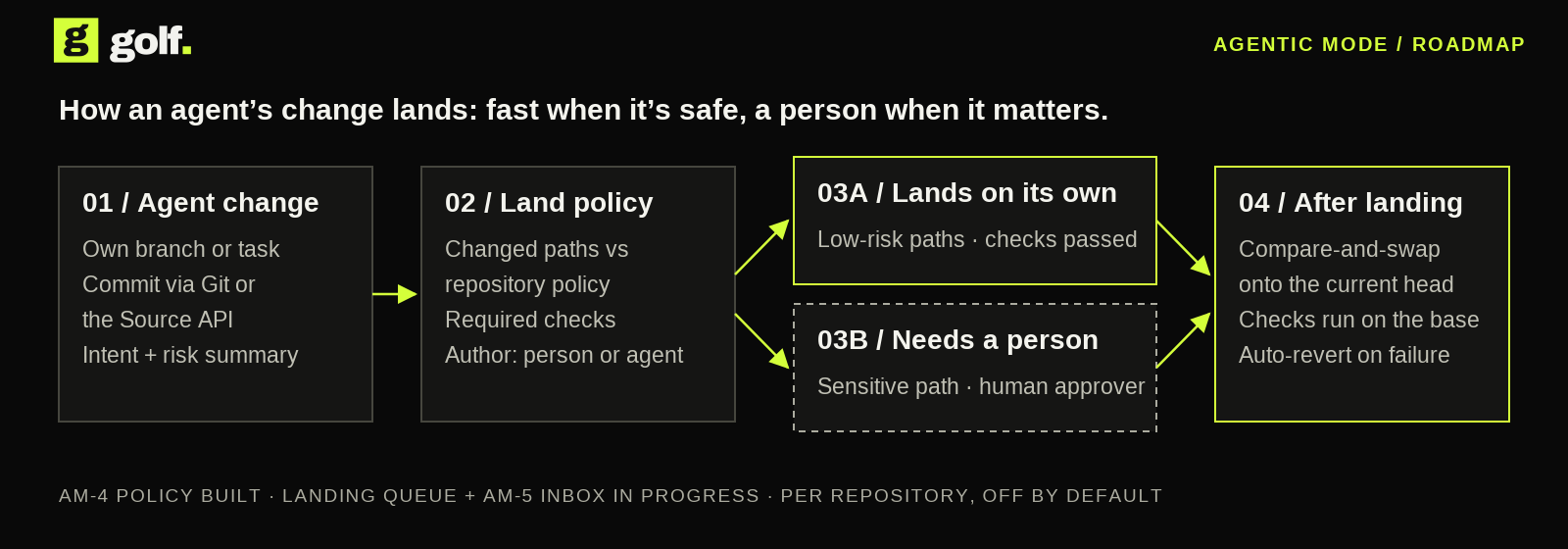
Merge onto the current head with a compare-and-swap, run checks after landing and revert automatically on failure.
Each change arrives with a summary of what it's for and what it risks. People approve in batches.
Low-risk changes flow through their checks. Sensitive changes always stop for a person.
 Editable architecture diagram · Open full size ↗
How agentic mode is designed: a repository setting, where a change lands without a person only when every rule allows it.
Each repository opts in. Administrators set policy for the installation, organization and repository.
Paths such as deploy/, auth/ and CODEOWNERS always need approval from someone who is neither the author nor an agent.
Agent tokens are limited to named repositories and branch patterns, and revocation takes effect on the next request.
Required checks must pass. Every landing is audited, and a change that breaks the base branch is reverted.
Golf doesn't lock you into one model. Connect the coding tools you already pay for, and run them where they make sense.
Claude Code, Codex and OpenCode, signed in with your own subscription or an organization key.
A Cloudflare sandbox per task, your own machines through the Golf agent host, or any host over SSH.
Code review, issue triage and improvement loops that open pull requests, each pointed at any repository and engine.
The foundation agents need is in place: real Git, review, checks and previews.
Hosted repositories, code review and history on Cloudflare Artifacts or Forgejo.
Supported Actions and GitLab workflows on configured runners, plus private previews of the tested commit.
Workers AI advice, review drafts and code proposals that return a tested patch for people to review.
Assign issues to agents on your machines, or, on Cloudflare, connect Claude Code, Codex and OpenCode over remote MCP with a scoped token.
Each milestone is measured before and after, and the results are checked into the repository.
Built and run on the hosted demo: pushes, clones and commits at 1–64 concurrent agents.
Measured on hosted: 64 agents pushing to separate branches, 93 of 93 land.
Measured on hosted: 16 agents commit without a clone, 48 of 48.
Verified on hosted: Claude Code opened a PR over remote MCP with a branch-scoped token.
In progress: diverged and squash merges and the landing policy are built; the lock-free queue is next.
In progress: intent and risk summaries for every agent change, approved in batches.
Same benchmark, before and after, against the hosted Cloudflare demo with up to 64 concurrent agents.
16 agents on separate branches: 0 of 32 pushes landed before. 48 of 48 after.
0 of 64 before. 93 of 93 after, with no lock errors.
64 agents cloning while others push: 62 of 166 succeeded before (104 refused). 70 of 70 after.
16 agents committing through the Source API: 48 of 48 at 1.85 commits a second.
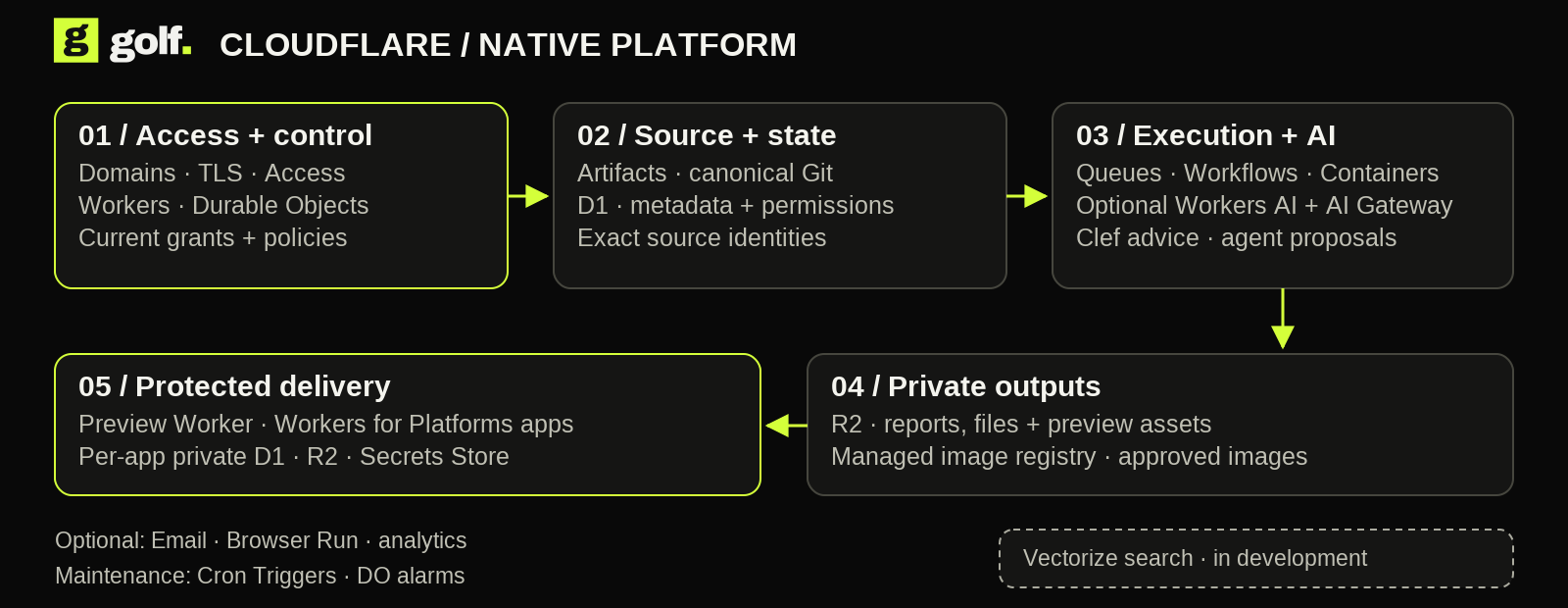
Golf doesn't build storage or schedulers. It composes Cloudflare services and removes the limits in its own control path.
Artifacts stores Git so that pushes to different branches don't have to wait for each other.
Durable Objects and D1 order only what must be ordered: since AM-1, branch updates, not whole repositories.
Containers give every agent task its own isolated working copy, started on demand.
Workers AI and AI Gateway run review and proposal models with policy and spend controls.
Every service has one job in the path from a change to a running preview.
 Editable architecture diagram · Open full size ↗
Git on object storage, records in SQL and coordination at the edge.
Serve the app, the Git routes and the APIs.
Store Git repositories and history on Cloudflare's storage.
Keep collaboration records, and coordinate pushes, reads and caches per workspace.
Keep private evidence, bundles and indexes; encrypt credentials with a stored key.
Every task gets its own isolated place to work, and every job is tracked to the end.
One isolated sandbox per agent task or check, with its own working copy.
Track the images that jobs use and produce.
Hand off background work, retry it in order and park failures in a dead-letter queue.
Run scheduled maintenance and real browser tests of previews.
A private preview of the tested commit, behind the same access rules as the code.
Host a temporary preview app per change, with its own data.
Check every reviewer at the door, on your own domain and certificates.
Tell people and systems what happened, with signed deliveries.
Keep busy agents and integrations within their budgets.
AI runs next to the code, with administrators in control of models and spend.
Run review, triage and proposal models, with allowed models, limits and usage recorded.
Search for what the code does, not only what it says.
Analytics Engine, the Analytics API and Workers Logs show what is running and what failed.
Deploy and operate the whole installation from one command line.
One product and one interface. Pick the infrastructure your team can operate.
Workers, Artifacts and D1 in your own Cloudflare account, with managed sandboxes, previews and AI. The agent-speed work starts here.
Forgejo, Go and PostgreSQL on one machine. The fastest way to start, with no Cloudflare or AI account needed.
The same portable stack on Helm, with optional external PostgreSQL and Forgejo. Verified on single-node k3s.
Deploy Golf into your own Cloudflare account, or explore the browser demos.
gitgolf.app/try ↗