Source and collaboration
Golf checks every Git request before it reads or updates Artifacts. Issues, pull requests, reviews and permissions live in D1. Anonymous reads need a repository that is explicitly public.
Golf runs natively on Cloudflare or on your own infrastructure with Forgejo. Both share one interface and one generated API, and each deployment keeps its own permissions and storage.
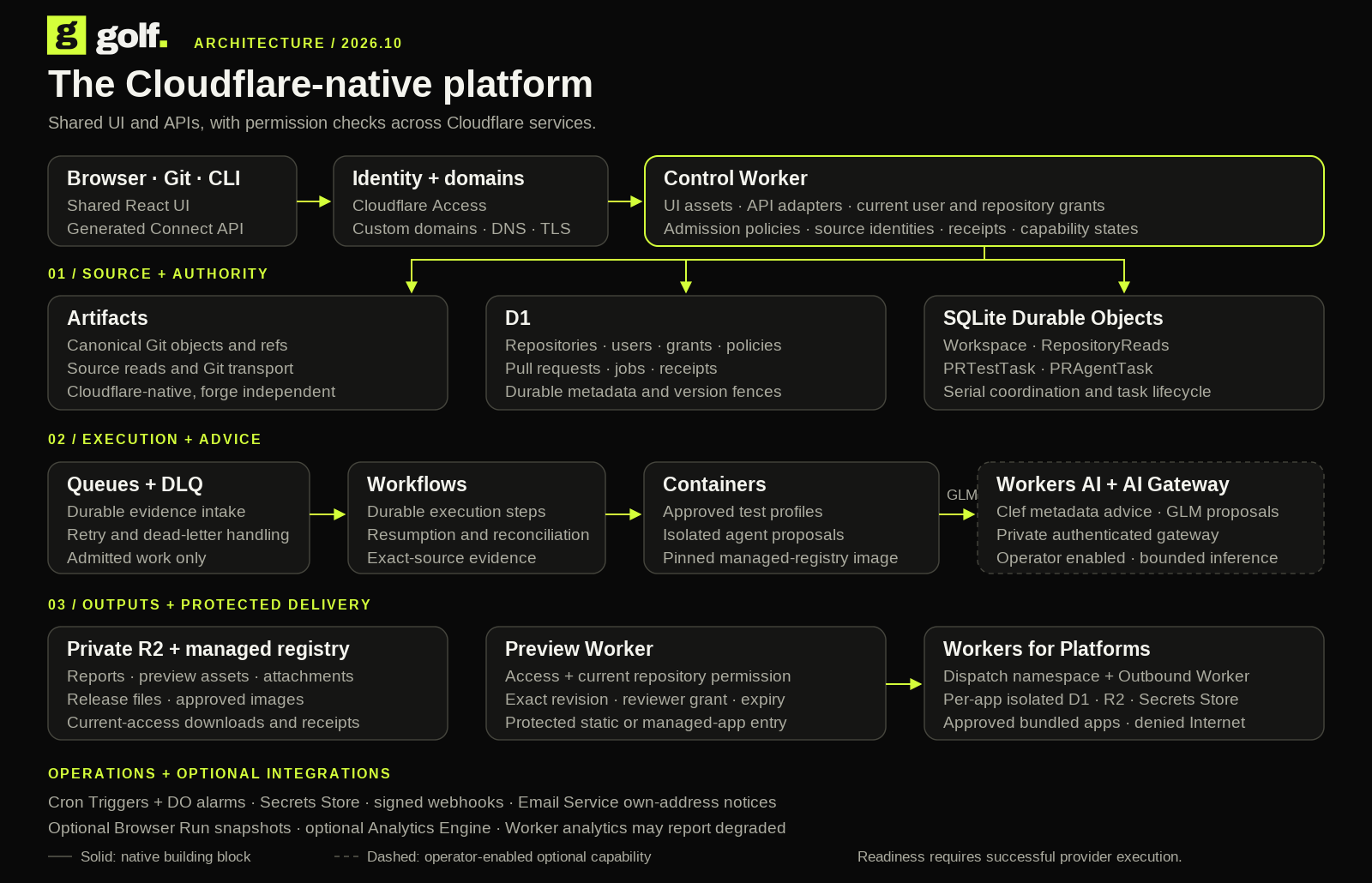
Alpha · October 2026Workers runs the application, Artifacts keeps Git on object storage, D1 holds collaboration records and Durable Objects coordinate shared state. Because Git already lives on object storage, the agent-speed work starts here.
Golf checks every Git request before it reads or updates Artifacts. Issues, pull requests, reviews and permissions live in D1. Anonymous reads need a repository that is explicitly public.
Queues holds requests, Workflows tracks stages and Containers runs approved tests and agent tasks. R2 keeps their reports and preview files. AI output goes to a person for review.
A preview Worker serves private static files. Workers for Platforms can run an approved app with its own database and storage. Access and Golf both check the reviewer’s permission.
Workers serves Golf and checks access. Durable Objects coordinate shared updates and jobs.
Artifacts keeps repositories and Git history on object storage. D1 holds accounts, permissions, issues, pull requests and job records.
Queues holds requests, Workflows tracks progress and Containers runs approved tasks. Optional AI returns advice or proposed changes.
R2 keeps reports and preview files. The registry stores runner images and images published by approved jobs.
A preview Worker serves static files. Workers for Platforms runs approved apps with their own data and storage.
Email and webhooks send updates. Job records, provider metrics and logs help operators trace failures.
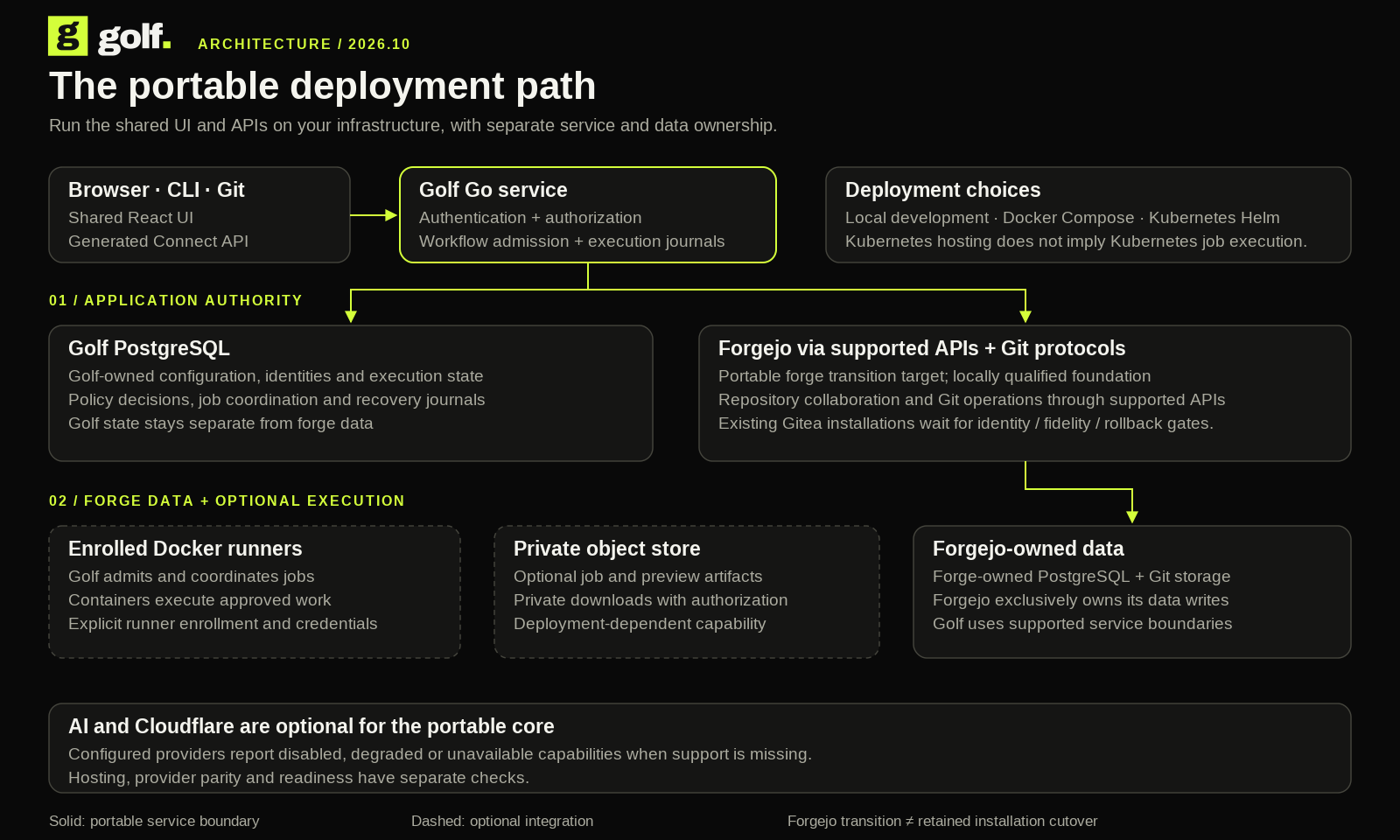
No Cloudflare account and no AI required.
The browser talks to Golf’s Go service, which uses supported Forgejo APIs for repositories and collaboration. Golf and Forgejo keep separate PostgreSQL databases, and Forgejo manages Git storage.
Helm installs Golf, Forgejo and optional PostgreSQL. You supply images, credentials, storage and HTTPS. Extra Golf API replicas share one Forgejo instance.
Configure test runners, private file storage and agents separately. The core Helm chart doesn’t install every job or agent service.
Sign-in identifies the person. Golf then checks their current permission for the exact repository and action.
Golf rechecks permission at documented steps before it starts work or returns private data. A cloud administration token never stands in for repository access.
When a provider’s answer is uncertain, Golf checks the stored result before marking the action complete. The interface reports an unknown outcome rather than assume success.
Initial native merging has passed hosted tests. Full protected merging, general production deployment, recovery and large-scale operation still need work.
Explore the local and Cloudflare browser simulations, or install Golf for real work.